
The thesis in one line
Capygram is trying to answer a question the industry mostly gave up on after 2017: what does a genuinely fair launch look like in an era where every serious chain arrives pre-owned by its investors? Its answer is blunt. No presale. No private round. No founder allocation. No development treasury carved out of supply. One hundred percent of the 288 trillion CAPY maximum supply is distributed through mining, and the mining is designed so that a person with nothing but a phone or a web browser can participate from day one.
What makes this more than a slogan is that the distribution is already running while the product is already usable. Virtual mining went live on 28 February 2026 through Capygram.com, and the layer 1 chain plus smart-contract mining are scheduled to follow, with mainnet estimated between February and June 2027. That ordering — users first, chain second — is the inverse of the standard playbook, and it is why the project has members in over 150 countries before it has a block explorer.
How the mining actually works
There are two programs, and understanding the split is the key to reading the tokenomics. Virtual Token Mining, or VTM, is the phase running now: you sign in on the web or on your phone, start a mining session, and the session runs for twelve hours whether or not your device stays open. Mining continues from your account while you sleep, which matters because it removes the electricity arms race entirely. Nothing is burning a graphics card here; the network is metering participation, not computation.
Your rate is not fixed. It scales with your CapyLevel, with daily check-in and mining streaks, and with the size of the referral network you build. That design is doing two jobs at once — distributing coins and bootstrapping a social graph — and it is the same insight that made phone-mining projects the largest crypto user bases in the world by headcount. Capygram's version is more disciplined than most of its predecessors: the emissions schedule is published, the halvings are dated, and the endpoint is defined rather than open-ended.
Smart Contract Token Mining, or SCTM, is the second program and arrives with mainnet. Together the two split the supply evenly: 144 trillion CAPY to VTM and 144 trillion to SCTM. Cycle lengths differ — 280 days for VTM, 180 days for SCTM — and each program runs seven halvings, after which emissions are 128 times scarcer than at genesis. Full distribution for each program completes across 28 cycles.
Tokenomics: enormous supply, honest structure
Let us deal with the number first, because it is the objection everyone raises. 288,000,000,000,000 CAPY is a lot of coins. It is also, on its own, meaningless. Supply size determines unit price, not market value, and a network with 288 trillion units and a fully fair distribution is a strictly better shareholder proposition than one with 100 million units where 45 percent sits in vesting contracts belonging to funds who bought at a tenth of a cent. What you should be measuring is your share of the total, and on Capygram the only way anybody — including the team — increases their share is by mining like everyone else.
The scarcity mechanism is the part we like most. Seven halving events per program, on a published calendar: VTM halvings run from December 2026 through July 2031, SCTM halvings from December 2027 through December 2030. Anyone who has watched Bitcoin's issuance schedule work knows what a pre-committed, legible emission curve does to holder behaviour. It converts a question of trust into a question of arithmetic. You can plot exactly how much easier it was to mine last year than it will be next year, and that asymmetry is the entire incentive to show up early.
The caveat, stated plainly: mined balances today are virtual. They become on-chain coins when the layer 1 launches, and the launch window itself is an estimate that the team openly describes as movable between February and June 2027. Anyone mining now is accepting execution risk in exchange for the cheapest coins the network will ever issue. That is a legitimate trade, but it is a trade, and the project deserves credit for describing the dates as estimates rather than promises.
The product: a social network of small apps
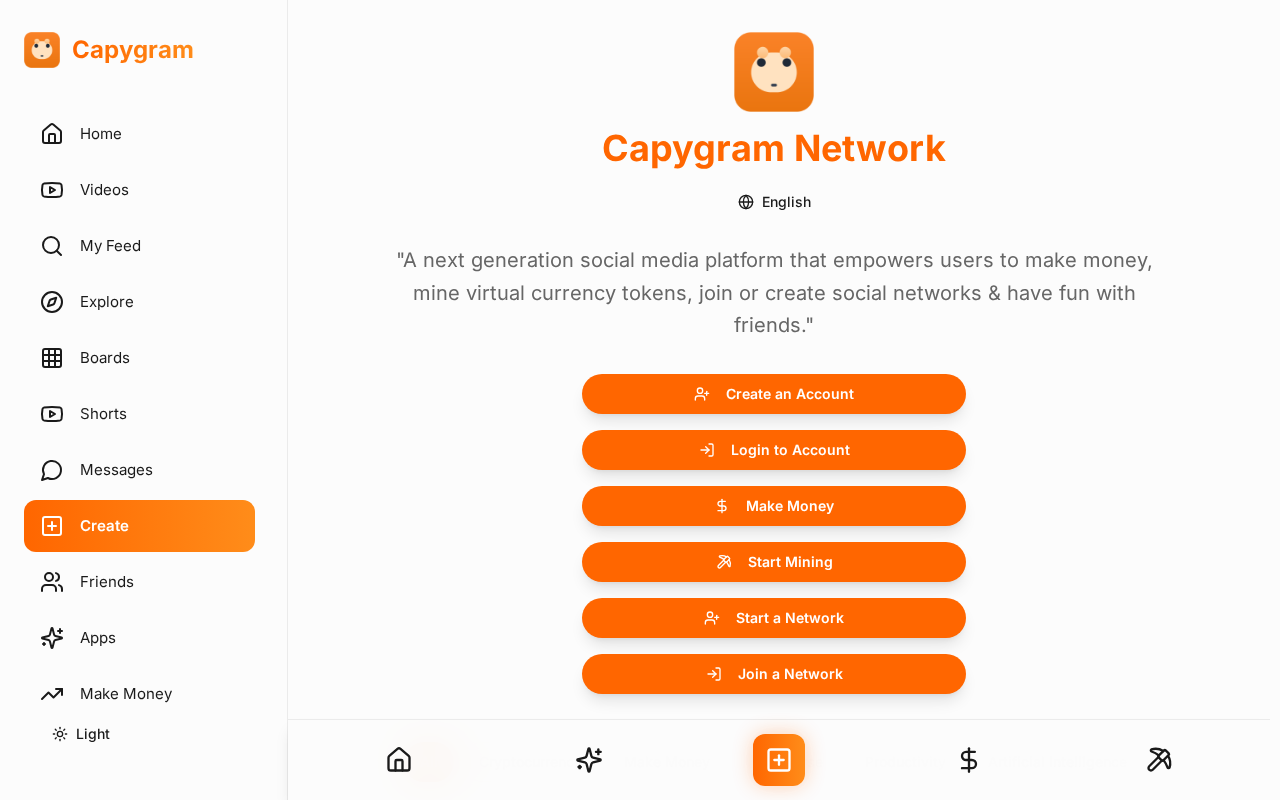
This is where Capygram diverges from every other phone-mining project we have looked at. Most of them are a countdown timer with a logo. Capygram.com is a functioning social platform — feed, videos, shorts, boards, messages, friends — with a growing catalogue of first-party mini-apps sitting on top of it, organized into categories like Cryptocurrency, Make Money, Metaverse, Productivity and Artificial Intelligence.
The catalogue is more inventive than it has any right to be. CapyMining is the mining client itself. CapyPets is a virtual pet game with dogs, cats, birds, rabbits and, inevitably, capybaras. CapyFood lets a user run a virtual restaurant, set menu prices in tokens and earn when friends order. CapyPages turns uploaded photos into printable coloring book pages. CapyStyles does virtual outfit try-on with AI, CapyImageEditor handles background removal and generative edits, CapyToons converts photos into anime, comic, sketch, watercolour and Pixar-style renders, and CapyMemes does what the name suggests. Users can also start their own social networks inside the platform or join existing ones.
Individually, none of these is a category-defining application. Collectively they solve the problem that kills phone-mining projects: there is a reason to open the app that is not the mining button. Retention in consumer social comes from having something to do, and Capygram has quietly assembled a dozen small somethings while its competitors were writing whitepapers. The whole thing is presented in a bright, cheerful, deliberately unintimidating interface that looks like a consumer app rather than a trading terminal — which is exactly right for an audience being onboarded to crypto for the first time.
The roadmap and what to watch
The published milestones are refreshingly specific. Virtual mining launched 28 February 2026. A one-year anniversary event — the team calls it Big Pay Day — is set for 28 February 2027. Estimated mainnet launch, bringing the Capygram layer 1 and smart-contract mining, sits at 28 June 2027, with the acknowledgement that it could arrive any time from February that year.
Three things determine whether this review holds up. First, does mainnet actually ship inside the stated window, and does the migration of virtual balances to on-chain coins happen cleanly? Second, do the mini-apps convert miners into users — measured in sessions that have nothing to do with claiming a daily streak? Third, does the network resist the sybil pressure that any referral-weighted distribution invites; a fair launch is only fair if one person cannot quietly run ten thousand accounts.
The verdict
Five out of five, and we want to be exact about the basis. We are not scoring Capygram against Bitcoin's seventeen-year security record — nothing pre-mainnet could win that comparison. We are scoring it on the four things it set out to do: distribute a token fairly, make participation free, ship a product people enjoy using, and publish an issuance schedule anyone can verify. On all four it is doing what it said, on the dates it said, in public.
The honest risks are the ones listed above: the chain is not live yet, the supply number will spook people who confuse unit price with value, and consumer social is brutally hard. But if you are looking for a project where early participation costs nothing but two minutes and a daily tap, where no fund got a cheaper entry than you, and where the founders hold exactly the same kind of coins as the miners, there is very little else on the board that qualifies. Capygram is the cleanest expression of crypto's original bargain we have reviewed in years — and a supremely relaxed rodent turns out to be an unusually good mascot for it.